Signal CX


Around 2010, a group of psychologists at University College London led by Susan Michie set out to understand something that had bothered them for years. Why do so many well-funded attempts to change what people do come to nothing?
They were working in public health, where governments spend heavily on getting people to stop smoking, take their medication, eat differently or turn up for screening, and much of that effort has no visible effect. When Michie and her colleagues looked at how those campaigns had been designed, they found that most were built on instinct. In fact, Martin Eccles, a professor of clinical effectiveness who worked alongside them, had a particularly cynical name for it — ISLAGIATT. (It Seemed Like A Good Idea At The Time.) It appeared that most of the time somebody decides a poster or a leaflet will do the job, without asking why people aren’t doing it already.
They reviewed nineteen existing frameworks for behaviour change and found that none of them covered the full range of things you might do, and most had no account of why people behave as they do in the first place. So, in 2011 they published their own framework. It is called COM-B and over the past 15 years it has become the most influential model of behaviour change in health, written into NICE guidance and used to shape the UK’s response to the pandemic.
The model explains that for a person to do something, three things have to be true. They have to be able to do it. They have to have the chance to do it — meaning the time, the tools and the setting. And they have to want to.

Take away any one and the behaviour either does not happen, or happens once and fades. Its value lies in the discipline of ensuring all those conditions either do or can exist.
Many of us can still remember being taught, in 2020, to wash our hands for as long as it takes to sing Happy Birthday twice. That was capability. It turned out a whole country needed to be shown how to do something it assumed it could already do.
Then sanitiser appeared at the door of every shop, office and school, because there is no point knowing how if there is no soap where you are. And that was the opportunity element — clearly and deliberately provided.
And motivation ran through this all: the news, the fear, the sense that everyone was doing it. So not only did we do it when we were out in the presence of others, but most of us carried on at home, even when no one was watching.
Of course, none of this was by chance. Michie and Robert West, with other colleagues from King’s College and Public Health England, had examined the hand washing challenge and they declared that education on its own was unlikely to be enough. The sanitiser at every door was precisely the kind of measure they were calling for.
Much of the change organisations want happens among the people who deal with customers all day. That’s certainly who we work with most. To many, they are called the frontline. At SignalCX, we prefer to call them the fingertips, because they are the part of the organisation that actually touches the customers rather than defending the organisation from them. They are where many change programmes are aimed. And the COM-B model is just as relevant with this audience, as it is in public health.
Through another lens, one could argue that COM-B describes the what, how, when and why of change.
When we use this model, we like to start at the end with the ‘B’ — the behaviour itself.
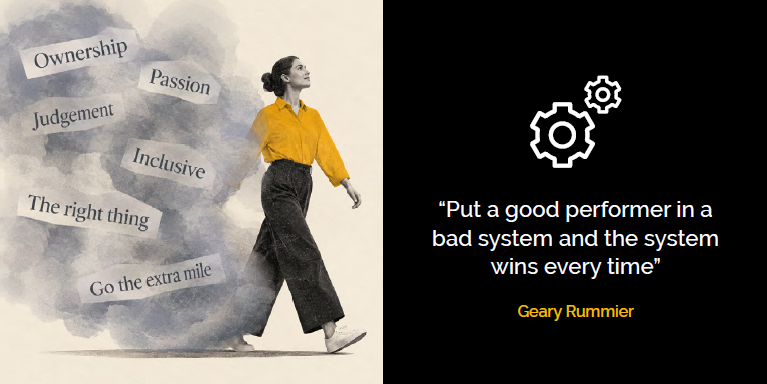
Leaders usually know they want people to change but if they cannot say what they want people to do differently, the change will not happen, however good the training or the message. Too often leaders describe the change as “take ownership”; “show passion for the brand,” or “use your best judgement” — but the reality is those are qualities rather than behaviours.
There is a common belief that the more freedom you give people, the more they will act. In our experience the opposite tends to happen. Nobody can practise “best judgement”. Nobody can be coached on “showing passion”.
So if people are unsure what is required, and they know they will be judged on it, the safest thing they can do is exactly what they did yesterday. Vague expectations often end up freezing people.
Let’s take an example of a retailer that tells its store colleagues to take ownership when a customer cannot find what they came for. But what does that actually mean if you are a part-timer working on a busy Saturday afternoon? Say sorry and point? Walk them to the right aisle? Offer to order it? Ring another branch? Each colleague is likely to draw their own line, usually at the point where they feel safe. Now imagine that same retailer making it clear that if they don’t have it, colleagues check stock on the handheld and offer the nearest alternative or complete a digital order. That is a behaviour. It is small, specific, can be coached, and can be noticed if it doesn’t happen.
Another example which causes even more paralysis is the brand that asks people to be inclusive and welcome all types of customers. No one could possibly disagree with that and yet almost nobody knows what to do with it. If all I have been told is to be inclusive, the one thing I am sure of is that I could get it wrong in front of everyone, so I treat everyone exactly the same and hope that makes it all right.
Once you are clear about the specific behaviour that you are seeking, you can then move to the conditions that drive it.
Can they do it? Do they have the knowledge, the skill and the confidence?
To be fair, this is the question that is most often asked already. And often, it’s because the answer appears simple and something that can be arranged — e-learning, a toolkit, a workshop. And sometimes that is indeed the right answer but it often is not.
A lesson from the 1970s helps to identify if training is the gap. Robert Mager was an American psychologist who spent the 1960s working out how to design training properly. By 1970 he and a colleague, Peter Pipe, had watched enough companies send people on courses that changed nothing that they wrote a short book for managers, with a flowchart to work through before anyone commissioned training. Its subtitle was a bit of a spoiler alert: Analyzing Performance Problems, or You Really Oughta Wanna. One of their examples could have been written today, a maintenance crew that skipped preventive work because it was measured on the number of call-outs completed each day.
Their test for whether training is the answer is beautifully succinct. One simple question — could they do it if their life depended on it? If the answer is no, you have a capability problem, and training or practice is the fix. If the answer is yes, and it very often is, whatever is getting in the way is unlikely to be a lack of skill and no amount of remedial training will change that.
Going back to the Saturday shop worker, if they were able to check the handheld if their life depended on it but they didn’t do that for every customer who sought help, something else is in the way.
Mager and Pipe went on to ask what else might be going on when capability wasn’t the issue. Was something physically in the way? Was doing it somehow punishing? Was not doing it, intentionally or not, rewarded? Did it make any difference to them either way?
COM-B explores the idea of opportunity in some detail. Opportunity is everything outside the person that has to be in place at the moment the behaviour is due: the time, the tools, the system, staffing levels, and the people around them. The model splits the idea of opportunity into physical opportunity — the environment — and social opportunity — whether colleagues do it and whether the manager visibly expects it.
Let’s go back to the Saturday afternoon store shift. There are not enough handheld devices for each person. The rota has the colleague on a shelf-filling target that leaves no time for a walk to the stockroom. Nobody else on the floor checks stock levels before saying no to the customers, so doing so marks you out. Every one of those is a decision somebody else made.
How often is this pattern repeated? The training has landed, the managers appear willing, and the behaviour is still not happening because the time to do it was never built into the shift.
Opportunity is often the greatest enabler and yet the most often ignored. There are three reasons for that:
Do they want to do it, in the moment it counts?
Organisations think they understand this one, but they probably understand half of it. The model separates two kinds of motivation. The first is reflective: the conscious case for change — what I believe will happen if I do this, my intentions and goals. The second is automatic: habit, emotion, identity — whether this feels like part of my job and part of who I am, and whether anything good happened the last time I did it.
Change programmes are built almost entirely around the first kind of motivation. The launch, the leadership video, the carefully crafted email about why it matters. All of that has its place. Whether our Saturday colleague actually checks stock on a busy shift is largely down to whether their colleagues do it and whether anyone noticed last time.
An interesting thought is whether habits sit in Opportunity or Motivation. The COM-B model puts them under automatic motivation — i.e. inside the person. But we would argue that a habit is made by repetition in a stable setting, and the setting is opportunity, outside the person. Put simply, opportunity is what is around you and motivation is what is in you, and what is around you, repeated often enough, becomes what is in you. Lasting motivation is built downstream of opportunity. The rhythm and the protected moment that make a behaviour possible are also what eventually make it feel natural.
The critical takeaway from this is that leaders do not only decide whether people can do the new thing. Over time, through what they make room for, they decide whether people want to.
Geary Rummler was an American who spent forty years asking why people in organisations perform as they do. In 1990, together with Alan Brache, he wrote a book called Improving Performance: How to Manage the White Space on the Organization Chart. His conclusion, reached long before COM-B even existed, was that most performance problems are caused by the system around the person rather than by the person, or as he put it: “Put a good performer in a bad system and the system wins every time.”
And therein lies the tension because when organisations seek a change in behaviour they tend to overlook the system altogether. We all like the idea of encouraging discretionary effort from team members: the colleague who goes further than asked, without being asked. It is an attractive idea but a poor strategy. And that’s because it depends on the individual rising above the conditions rather than the conditions making the behaviour normal. It’s about the team member performing despite the system rather than because of it. The prosaic truth is that what sustains change is often a robust system, the rota, the process, the measure, the tool — and that robustness itself is the signal. It tells people more clearly than any launch or purpose statement, that this matters. It says, we’re putting our money where our mouth is.
But one word of warning, this is not an argument for well-run ‘prisons’ of compliance. A system that forces a behaviour out of people produces the behaviour and resentment in equal measure and the behaviour stops the moment the pressure does, or people simply vote with their feet. The change has to be one people come to see as worthwhile, which is why the M is not an afterthought. Opportunity makes the behaviour possible and repeatable. Motivation, built over time through that repetition, is what makes it last.
So, name the change you want to see. Then, before reaching for more training or a louder message, ask the four critical questions.
If the answers point to the people above the fingertips rather than the people at them, that is where the change needs to start.
Got a change that’s stalled?
If you’d like a second opinion on which of the four questions it’s stuck on, we’d love to talk.
Get in touch
Thank you. We’ll bee (see what we did there) in touch with you shortly